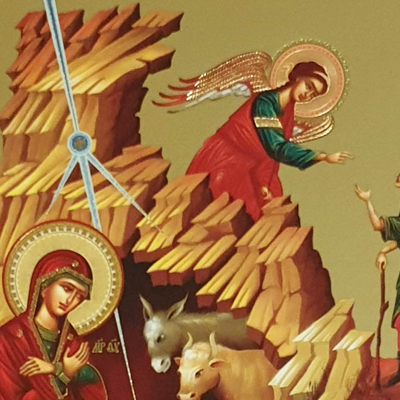
Icon of the Nativity of Jesus Christ – Your Guide to Iconographic Symbolism
As we approach the Feast of the Nativity of our Lord this Wednesday, January 7 (December 25), we prepare to stand before the icon of the Feast.
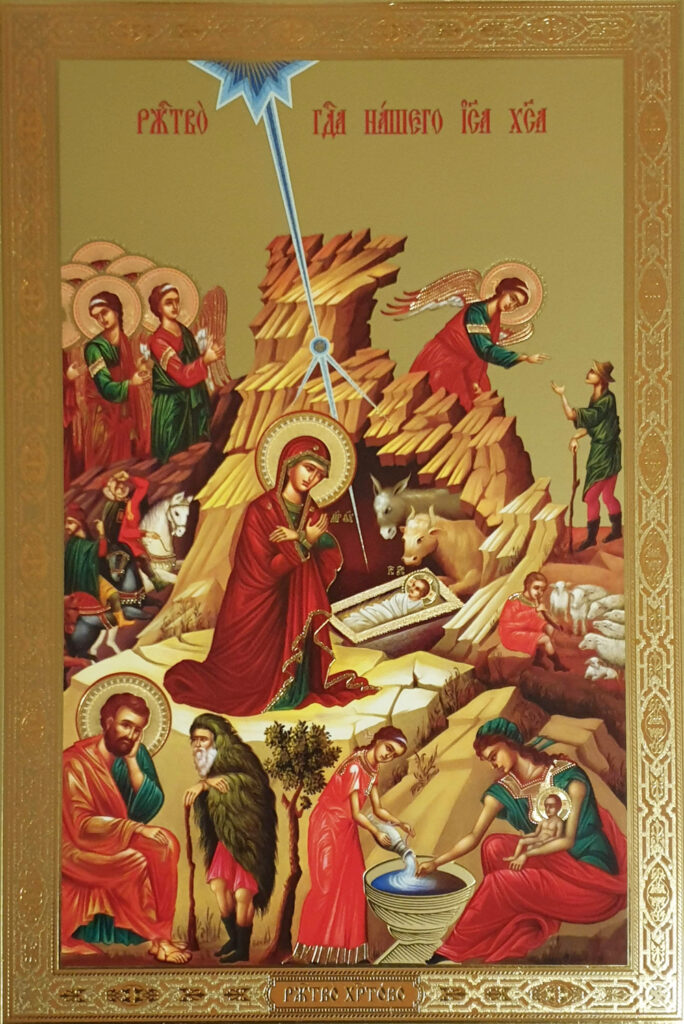
When you venerate the icon of the Nativity of Christ, look for these specific details. Each brushstroke tells a story of prophecy, humanity, and divine love.
The Central Mystery: God Enters the Darkness
At the center of the icon, we do not see a palace, but a dark cave.
- The Cave: The black opening represents the world darkened by sin. Christ, the “Sun of Righteousness,” enters the deepest, darkest part of the earth to bring light from within.
- The Manger as a Tomb: Notice that the manger is shaped like a stone coffin (sarcophagus), and the Christ Child is wrapped in white swaddling clothes that resemble burial shrouds. This visually connects His birth to His death; He was born specifically to die for our salvation.
- The Ox and the Donkey: Hovering over the manger are two animals, fulfilling the prophecy of Isaiah 1:3: “The ox knows its owner and the donkey its master’s crib; but Israel does not know.” They represent the entire created order—and arguably the Jewish and Gentile nations—recognising their Creator when humanity failed to do so.
The Theotokos: The Uncut Mountain
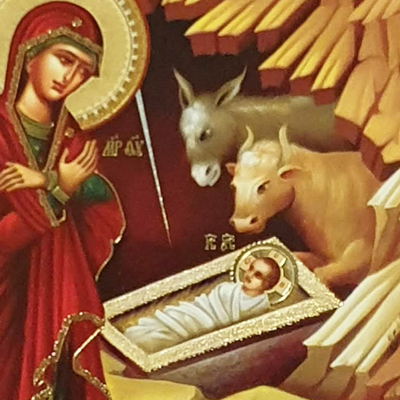
The Virgin Mary is typically the largest figure in the icon, emphasising her pivotal role.
- Her Posture: She often rests on a red cushion (symbolising the burning bush) or a rocky bed. In many icons, she looks away from the child and toward St. Joseph (and us), showing her role as an intercessor for the world.
- The Mountain: The jagged, rocky mountain surrounding the cave refers to the Virgin herself as the “Mountain Uncut by Human Hands” (Daniel 2:34-35).
- Cracks and Flowers: You may notice cracks in the hard rocks near her, with small plants growing through. This fulfills Isaiah 35:1: “The wilderness and the wasteland shall be glad… and the desert shall rejoice and blossom.” It signifies that Christ’s birth has broken the hard shell of the old world, bringing life from barrenness.
Heavenly Sign: The Star
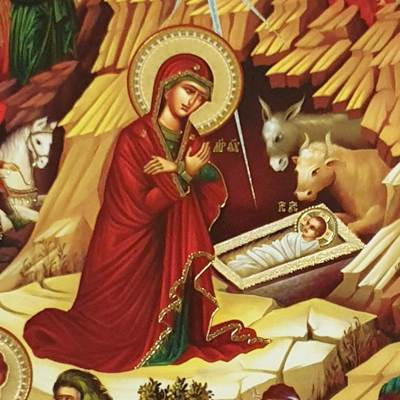
At the very top of the icon, the heavens open.
- The Three Rays: A single star descends but often splits into three distinct rays as it touches the cave. This represents the Holy Trinity—the Father sending the Spirit to reveal the Son.
- The Light of Knowledge: The star represents the light of wisdom, leading the “stargazers” (Magi) away from astrology and toward the Truth.
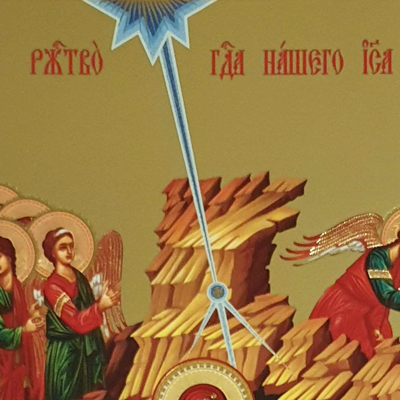
Heavenly Choir: The Angels
At the very top left of the icon, the group of Angels represent the Heavenly Host. They are not speaking to men; they are singing to God.
- They symbolise the unending worship of Heaven, specifically the hymn: “Glory to God in the Highest, and on earth peace, goodwill toward men.”
- Their presence confirms that the Nativity is not just an earthly event in a small cave, but a cosmic event that the entire universe is celebrating.
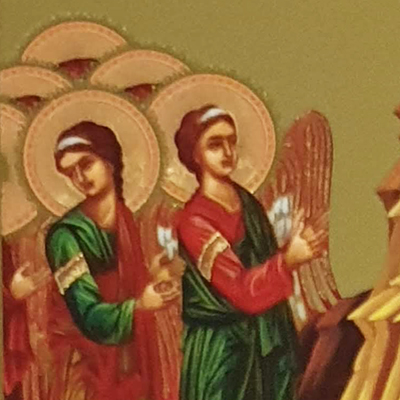
The Mystery (Angelic Astonishment)
It is not so explicit in this icon, but in some icons the angels on the left are looking intently down at the cave/star, and their posture is one of deep contemplation or awe.
- “Things into which angels long to look”: This references 1 Peter 1:12. The Incarnation—God becoming human flesh—was a mystery hidden from the ages, even from the angels.
- The angels are depicted as being astonished. They are witnessing their Creator taking on the form of a creature (a human baby). It emphasises that God’s humility is so profound that even the highest spiritual powers are stunned by it.
The Covered Hands (Reverence)
IfIn some icons, the angels in the top left have their hands covered by their outer garments (mantles).
- Byzantine Court Protocol: In the ancient world, it was considered disrespectful to touch a holy object or receive a gift from an Emperor with bare hands.
- The Theology: By covering their hands, the iconographer is showing that this event is too holy even for angels to touch. It emphasizes the absolute sanctity of the Christ Child.
The Twofold Ministry
The placement of the angels creates a balance in the icon that teaches us about the spiritual life:
The Lesson: We are called to do both. We must have times of quiet prayer and awe (like the angels on the left) and times of sharing the Good News (like the angel on the right).
Left Side (Worship): These angels turn inward toward God in prayer and wonder.
Right Side (Service): The other angel turns outward toward the shepherds to share the news.
Witnesses: Wisdom and Simplicity
The top corners of the icon contrast two different ways of finding God.
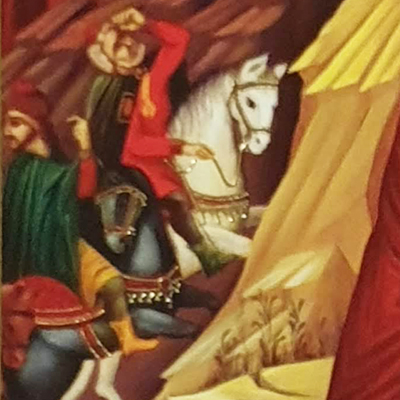
- The Magi (The Wise Men): On the left, they ride on horses, representing the Gentiles and the intellectual searchers of the world. They show that human wisdom and wealth must journey far to bow before the King.
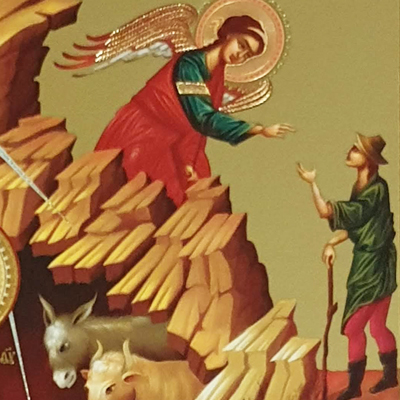
- The Shepherds: On the right, rough-clad shepherds listen to the angels. They represent the humble, simple hearts who receive the Gospel immediately through faith.
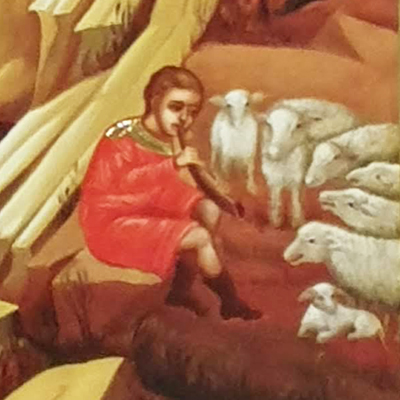
- The Shepherd Boy and the Flute: In the lower scenes, you may see a young shepherd playing a flute. This represents the joy of the creation. However, often a single lamb looks away, ignoring the music and the cave. This warns us against being “distracted” by the world, even when a miracle is happening right beside us.
Human Struggle: St. Joseph and the Tempter
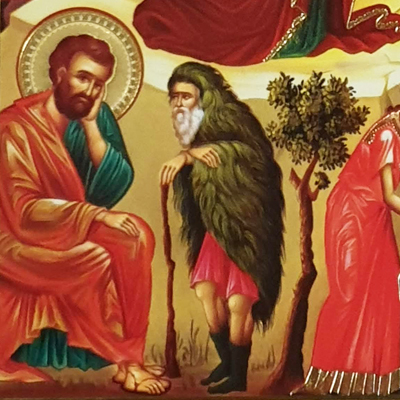
In the bottom left corner, St. Joseph sits away from the center, looking troubled.
- The Doubt: He is not shown as the biological father, but as the guardian. His posture—head in hand—shows his confusion and struggle to understand the Virgin Birth.
- The “Old Man”: Standing before him is a ragged, hunched figure (often dressed in animal skins). This is the Devil (or a demon disguised as an old shepherd) tempting Joseph with doubts, whispering that a virgin birth is as impossible as a dry stick sprouting leaves.
- The Answer (The Jesse Tree): Between Joseph and the rest of the icon, there is often a small tree or shrub. This is the “Rod from the stem of Jesse” (Isaiah 11:1), confirming that despite Joseph’s doubt, this birth is the true fulfillment of King David’s lineage.
Proof of Humanity: The Midwives
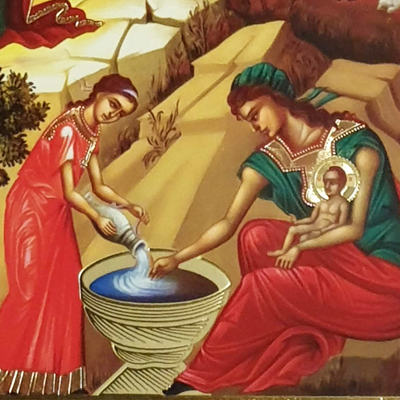
In the bottom right corner, two women (traditionally named Salome and Zelomi) are seen bathing the infant Jesus.
- Why Wash God? Christ did not need cleansing, but this scene proves His full humanity. He was a real baby who required care. It dispels the early heresy that Christ was just a spirit or a phantom.
- The Basin (The Font): The basin is often shaped like a baptismal font. The water sometimes has two tones (dark and light), symbolising the “washing” of the waters of creation.
- The Colors: One midwife often wears Red (humanity/blood) and the other Green (life/spirit), showing that through this human birth, life is restored to the world.
The Two Women: Salome and Zelomi
According to Holy Tradition (the Protoevangelium of James), Joseph went to find help and brought back two midwives.
- The Woman in Red (Zelomi): She represents the first witness to the birth. In many traditions, she is the one who recognised the miracle immediately. Red often symbolses life, blood, and humanity. Her solid red garment emphasises that she is a witness to a real, physical human birth.
- The Woman in Red and Green (Salome): Salome is a famous figure in the tradition. Initially, she doubted that a Virgin could give birth. When she tried to examine the Virgin Mary, her hand withered as if by fire (a sign of the holiness of the event). She then repented, touched the Christ Child, and was healed.
- The Colors: The combination of Red (humanity/suffering) and Green (new life/salvation/the Holy Spirit) on her clothing symbolises her transformation from a state of doubt to a state of grace and healing.
The Different Colours of Water
In many icons, the water in the basin is depicted with two distinct tones (often a darker, muddier color on one side and a clear or blue color on the other).
- The Transformation of Nature: This symbolises that the “old water” of the world (sin and death) is being transformed into “new water” (grace and baptism).
- Stirring the Water: The midwife is seen “stirring” or testing the water. This symbolises that Christ is entering into the physical elements of the earth. By stepping into the water, He is sanctifying it—foreshadowing His own Baptism in the Jordan where He would bless the nature of water for the whole world.
The Baptismal Basin
Notice that the bowl isn’t just a tub; it is often shaped like a Baptismal Font.
The act of pouring and stirring represents the cleansing of the human race. Just as the baby is washed clean of the “messiness” of birth, humanity is being prepared to be washed clean of the “messiness” of sin through Him.
Washing the “Unwashable”: Paradoxically, the Church teaches that Christ was born “without defilement” and didn’t need a bath. He submitted to being washed to show He was truly human, but also to “wash the world.”
Ascend to Heaven: Mountain Steps
At Diving Liturgy on 7th January: When you see this icon, remember the “Steps” carved into the mountain. They remind us that the Nativity is not just a story to watch, but a mountain to climb.
The heavens have come down to the earth so that we—through the fast and our prayers—might ascend to heaven.